

How to Audit Your Writing Resources
Curate what nourishes, not depletes.

I’ve been thinking about how we fill our creative containers. More importantly, about what happens when we’re not intentional about what goes inside them. During a recent workshop I gave, we spent time exploring the idea of auditing our writing resources. Not all are created equal. Some fill us up; others quietly drain us.
As we move through this season together, I’d like to invite you to examine your own collection through three categories:
📚Nourishing resources are the ones that make you want to open your laptop with genuine excitement. They might be craft books that speak directly to your struggles, courses that unlock something inside you, or podcasts that energize your imagination. These are the friends who show up for you, again and again.
📚Draining resources are trickier to identify because they often come dressed in promise. They’re the ones that make you want to close your laptop and walk away—whether because they compare you to others, overwhelm with noise, or simply don’t align with your creative needs right now. There’s no shame in releasing them.
📚Neutral resources are interesting, perhaps even valuable, but not essential to your particular writing. They’re fine to have around, but they don’t need to take up your sacred time and mental space.
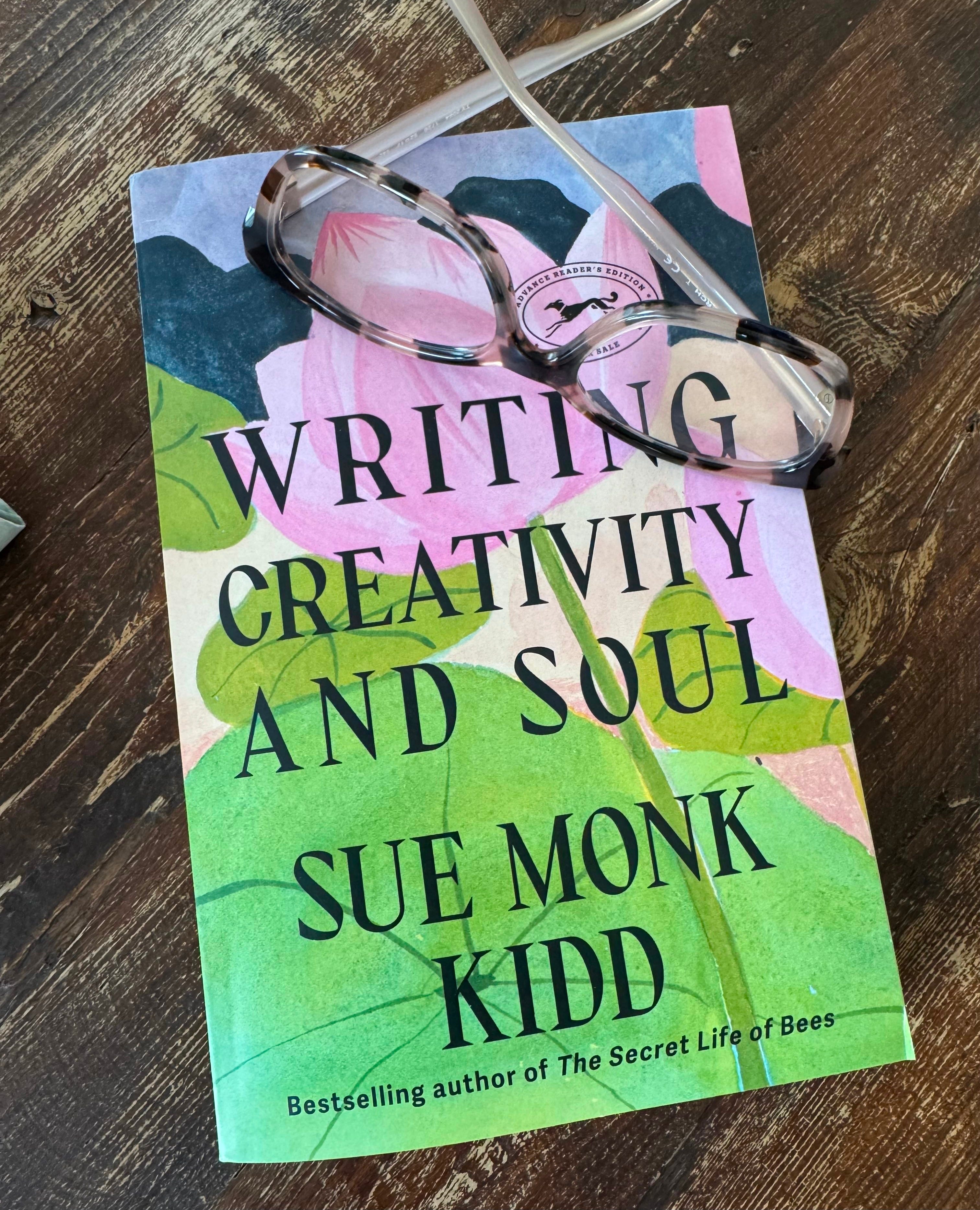
Something tender happened this year that reminded me of the power of meaningful resources.
For many years now, Sue Monk Kidd has been a mentor to me—even though we’ve never met. I’ve poured over nearly every one of her titles: The Secret Life of Bees, The Invention of Wings, The Book of Longings. In interviews and talks, I’ve watched her open her heart with such grace and spirituality, such profound self-awareness. She’s taught me not just through her words, but through the way she shows up in the world.
Last year, when Kidd announced her diagnosis of Parkinson’s Disease, something broke open in me. Because eighteen years ago, I lost my mother to that same cruel disease. The grief moved through me in ways I didn’t expect.
So you can imagine the pure, layered joy I felt when I reached out to Kidd’s publicist and received not just a response, but an advanced reader copy of her newest book, Writing Creativity and Soul, in my mailbox. This book, which is part memoir, part philosophical investigation, and part advice to aspiring writers, felt like so much more than paper and ink. It felt like a gift from the universe, wrapped in her words.
I will cherish this copy, just as I’ve cherished her other titles, because it represents a connection that’s mattered to my creative life and my heart.
This is what I mean when I talk about nourishing resources. They’re not just informational. They’re spiritual. They’re personal. They’re the ones that remind us why we write in the first place.
“The common heart is the place of our deep and shared belonging. As a writer, I believe in this place. I find meaning in the hope that a writer’s work can be a portal into it.” - Sue Monk Kidd
Now, on to this week’s podcast episode of The Whole Writer: How to Choose the Voices That Belong in Your Creative Space. Tune in here.👇🏻
Every week, The Whole Writer podcast creates space for writers to nurture both their craft and themselves, exploring what it means to write from a place of wholeness rather than depletion. You can find episodes:
📍 Here on my Substack
📍 Apple Podcasts
📍 Spotify
Enjoyed this episode, Nicole. And I've received inappropriate criticism from critique partners and felt the pain you explained. Fortunately, I let their critism go and moved on.
You have clues as to where to find critique partners on Instagram who know my genre (mystery -thriilers), but would you recommend Direct Messaging instagrammers and outright asking, or is there another strategy for identifying appropriate partners?